
Dark Social Traffic: The Hidden Reach Google Analytics Can’t Track
Imagine that while looking at the reports in Google Analytics, you noticed that you had more traffic than your marketing efforts usually bring. This traffic is usually mixed with kinds of traffic like traffic from direct sources or social media, which makes it hard to figure out where the visitors are actually coming from. You might have also talked to customers who say they found your website through WhatsApp, Telegram, email, Slack, or some other private messaging platform. Your analytics reports do not show those channels.
This kind of traffic is called dark social traffic. When people share things on private platforms, those platforms usually do not send any information about where the traffic came from, so Google Analytics just says it is direct traffic. Because of this, businesses might think their content marketing, email campaigns, and word-of-mouth sharing are not working as well as they really are. If you understand this hidden traffic, you can make better decisions about your marketing, understand which channels are really working, and find out what is driving people to engage with your website and convert.
In this article, you will learn:
- What dark social traffic is
- How to find it in Google Analytics: How to Use Dark Social Traffic Insights to Increase Conversions and Optimise Your Marketing Efforts
We will also share some things you can do and give you real examples that helped people find hidden traffic, improve how they measure.
What is Traffic?
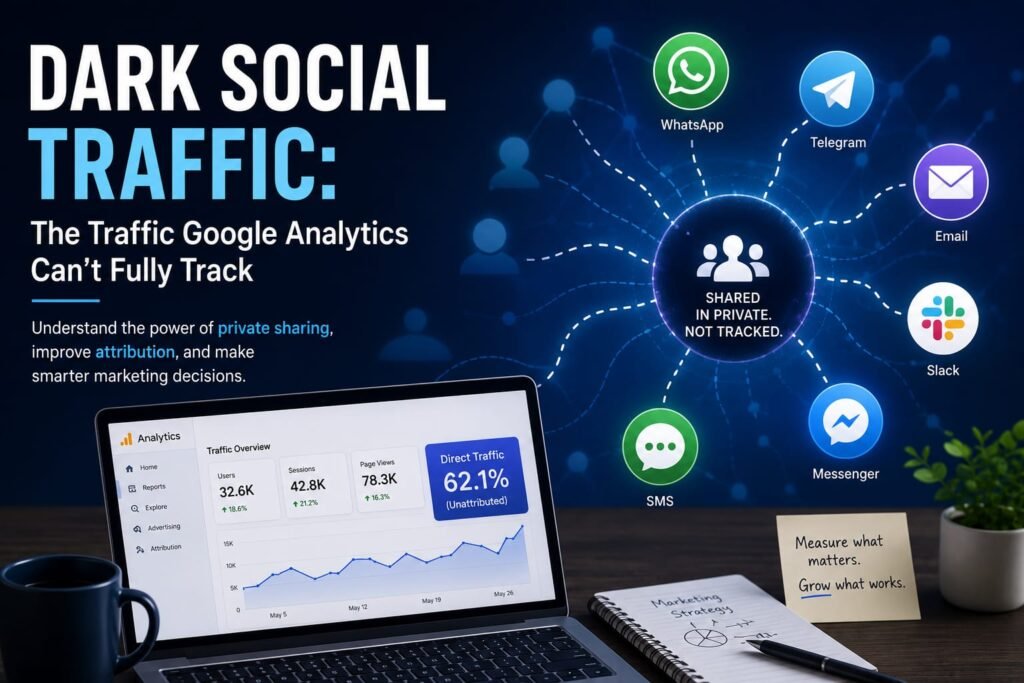
People communicate with each other using messengers. And they share links with their friends and colleagues. The traffic generated by these links is called dark social traffic. It comes from social sharing of content and has complex and non-trivial measurement. The problem of interaction through messengers is tangled with other traffic, making it almost impossible to separate it from the rest. This traffic is still valuable, as it reflects people’s interactions with your brand/products. The key point in the definition of dark social traffic is that it comes from private communications. Therefore, it differs fundamentally from social network traffic. The reason for this is the privacy of messages, due to which it is difficult to get an accurate picture of traffic distribution and statistics.
In particular, private social network activity is not available for analysis in Google Analytics. As a consequence, the visits that occur as a result of the correspondence are presented as direct visits. This makes it difficult to quantify the impact of dark social traffic on the effectiveness of campaigns, as well as assess the contribution of each channel. Even if this type of traffic does not appear to be a significant source of visits, it still distorts conversion and other metrics. Understanding the nature of dark social traffic is essential for conducting a complete analysis of any business’s click-through rates and conversion rates. So, having considered what dark social traffic is, let’s take a closer look at how to count it in Google Analytics.
How to Find Dark Traffic in Google Analytics?
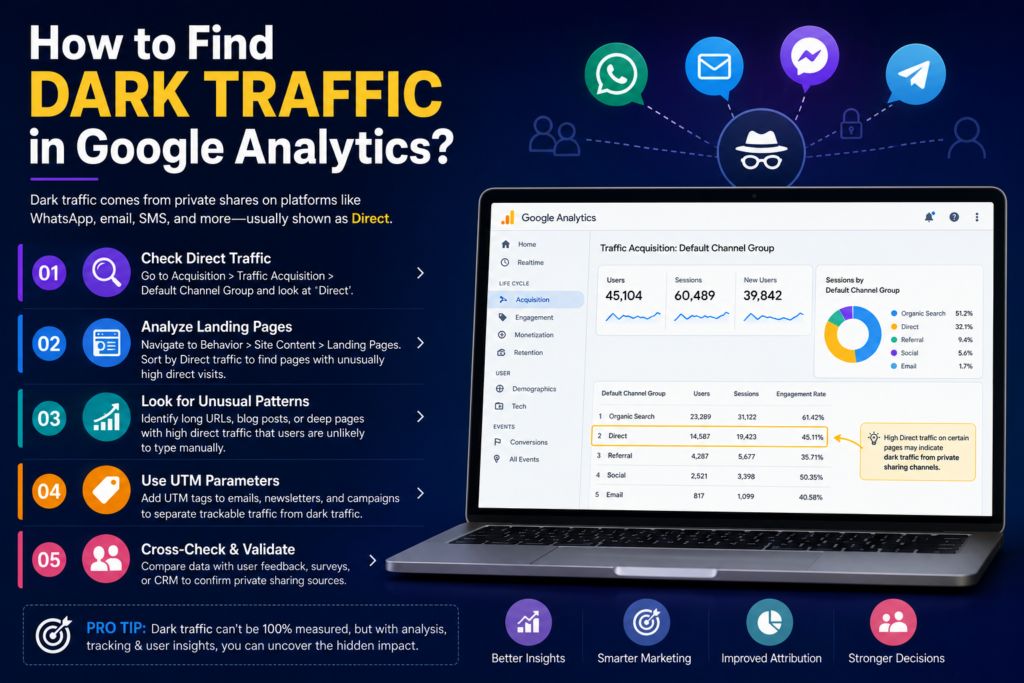
A long URL is an indicator of dark social traffic via messengers to the landing page. Normally, a page with a URL has fewer visitors than a standard page. As a result, if you notice that a page with a URL has an unexpected traffic spike, this may indicate that you already have customers who find you through messengers. Long URLs, along with the following indicators, may also help identify dark social traffic:
- views of content with long URLs,
- traffic growth without any particular reason;
- content with long URLs that went viral but is represented in the statistics as direct or social traffic with a low number of social shares.
Having identified areas in your Google Analytics, let’s move on to figuring out how to find dark traffic and work with it.
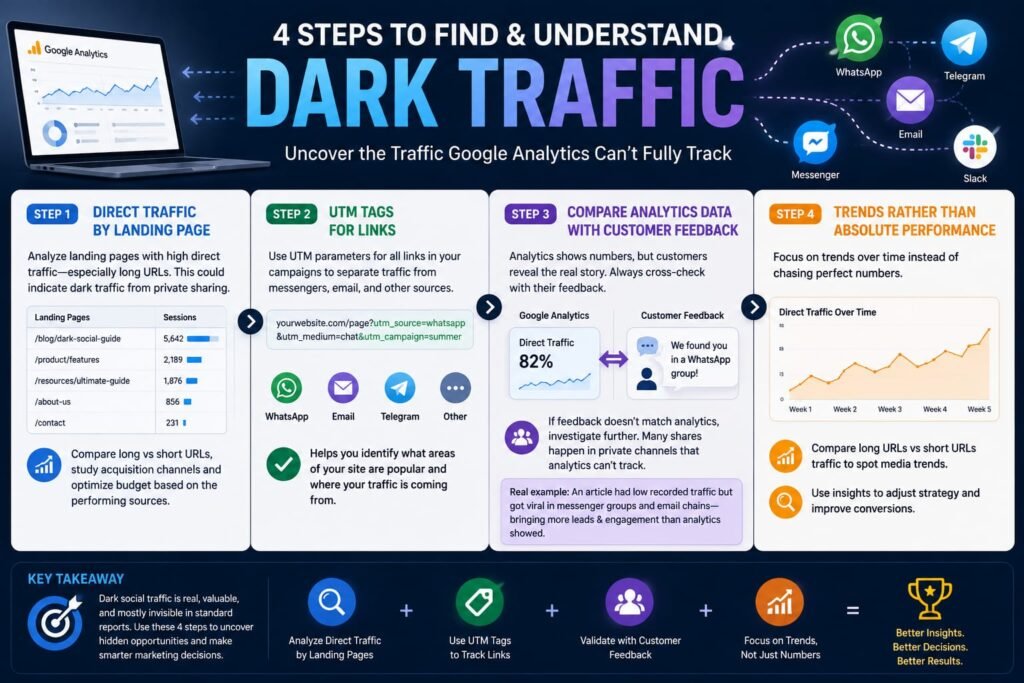
Step 1. Direct Traffic by Landing Page
Direct traffic consists of users who entered the address of your page in the search engine or added the page to their bookmarks. Direct traffic also includes users who got to your page via messengers or email by following the link. Therefore, direct traffic is divided into two categories: bookmarks or direct entry, and users who got to your page from messengers, WhatsApp, Telegram, and other platforms. Dark traffic is one of the two types of traffic and is essential for your marketing campaign.
Thus, if in your statistics the landing page with URLs has a considerable amount of direct traffic, it indicates that this particular URL performs well. Moreover, it is essential to examine the ratio of traffic to marketing sources. It is a good idea to study the acquisition channels and see if long URLs are in them. To find the performing marketing channels, it is a good idea to analyse the ratio of entries with long and short URLs. It might also be helpful to optimise the budget according to the traffic source.
Step 2. UTM Tags for Links
To figure out where dark social traffic is coming from, you can add UTM tags to every link. This way, you can see where the traffic from messengers is coming from and separate it from traffic that comes from email and other places. UTM parameters are really useful because they help you see which marketing campaigns and ads work best with your clients and what they like.
When you look at the numbers and the UTM parameters you can see how much traffic each campaign and source brings to your website and how well they work. Then you can see which campaigns bring the traffic and have the best results. This information will also help you make your marketing strategy better because you will know where the traffic from messengers is coming from and which sources bring the visitors. UTM parameters can also be used to make your websites marketing campaign better because they show you what works and what you need to change to get more traffic and turn it into visitors.
To sum it up, UTM parameters are really tools that you should think about using for marketing. First, they help you know where the traffic from messengers is coming from and separate it from other sources. Second, UTM parameters show you what your audience likes, which helps you make your website’s marketing campaign better and attract more visitors from dark social traffic.
Step 3. Compare Analytics Data With Customer Feedback
Customer feedback can give you information that analytics tools might not. Ask your customers how they found your website when they sign up, when they check out, and through a survey. This easy method will show you where they came from and let you see if dark social traffic is playing a role in bringing people to your website.
Customer feedback is another way to look at how your work to be seen is working and what parts of traffic you might be missing. If many of your visitors say in their comments that they found you through messages on social media, that means the numbers are putting these visitors in the wrong category. You can also use customer feedback to check against the data from your landing pages and UTM tags. This kind of information will help you understand how much dark social traffic is really helping your business.
Step 4. Trends Rather Than Absolute Performance
While looking at traffic data it is important to pay attention to trends rather than just numbers. When talking about trends it is necessary to check how URLs perform and how short URLs get traffic to find out how people share things privately. Marketers also need to look at traffic after campaigns to get a better idea of how dark social traffic is shared through private channels and how that affects people’s interest. So after talking about how to measure traffic from different sources you can see that it is not very hard. Using these methods helps companies find traffic better, improve how they track where it comes from, and make more people take action. Even though it is not possible to track every share, using different tools for analysis gives a better view of what customers do, how well marketing works, and how to improve dark social marketing strategies. To wrap up, let’s look at the key details about dark social traffic.
FAQs
Q: What is dark traffic?
A:Dark traffic is generally understood as traffic from sources that are not known. This kind of traffic is hard to measure and follow because it comes from different places. Dark social traffic mainly comes from messages, emails, text messages, and private conversations on media. The main issue with traffic is that it is not clear where it is coming from. In other words, the origin of this traffic is not visible. Tools such as Google Analytics can help spot this traffic. They do not offer a lot of details about where the traffic is from. This shortage of details makes it hard for marketers to know where this traffic is coming from.
Dark traffic is helpful because it shows that people are interested in a company. Dark traffic shows that users are passing on information about a business’s products or services to their friends. It also helps measure how much trust people have in a company. If the amount of traffic can be found out, it will be possible to improve the marketing plan of a company as well as find out which online websites allow the company to share its products or services most effectively. Dark traffic also helps identify which topics are popular with users and which ones are not. This information is valuable for dark social marketing, as it helps businesses improve their strategies, make better predictions, and make data-driven decisions.
Q: Can dark traffic be measured?
A: Dark traffic cannot be measured directly; the methods described above allow analysing sources and comparing them to marketing efforts. At the same time, marketers should pay attention to the value of URLs, direct entries, and customer support data. It is also necessary to focus on UTM parameters, shortened links, and campaign tracking to get an accurate understanding of dark social traffic. In addition, analysing the landing page, user behaviour, and conversion data can help marketers find the source of dark traffic. Moreover, comparing direct traffic data before and after marketing activities helps estimate private sharing results. It is vital to remember that business owners will never be able to track all visitors, so it is essential to use various analytical tools to get more accurate data on customer behaviour, measure marketing performance, and strengthen dark social marketing strategies.
Conclusion
For the business owner, dark social traffic is really interesting. It is very important to understand how people find and share information about the business owner’s resource. The Google Analytics tool is not able to provide all the information about the number of users who find the site through WhatsApp, email, Telegram or another social media network. The business owner can look at the pages these users visit and use the same UTM parameters and learn about the behaviour of the customers the business owner gets. This helps the business owner figure out what to do to make the site better. The business owner should not stop at the level of analysis. The business owner has to keep going and make the system for tracking traffic from networks better all the time. People use networks every day.
So understanding how social traffic works gives the business owner a chance to make marketing decisions and measure how much money the business owner gets back from the money the business owner spends. The business owner can also create content that attracts customers and helps the business. The analytics tool is useful for looking at where the traffic comes from and how users behave when they find the site in the way. This information is not always helpful for figuring out how much money the business owner gets back from social campaigns. The business owner should know that dark social traffic has an impact on how information spreads. So it is very important to look at social traffic and analyse it to find new ways to make the content better.